
Hey Friends! Happy Friday! Please forgive my absence this week! We were working on a 4 day commercial and that left no time or energy for blogging, returning e-mails or anything else!
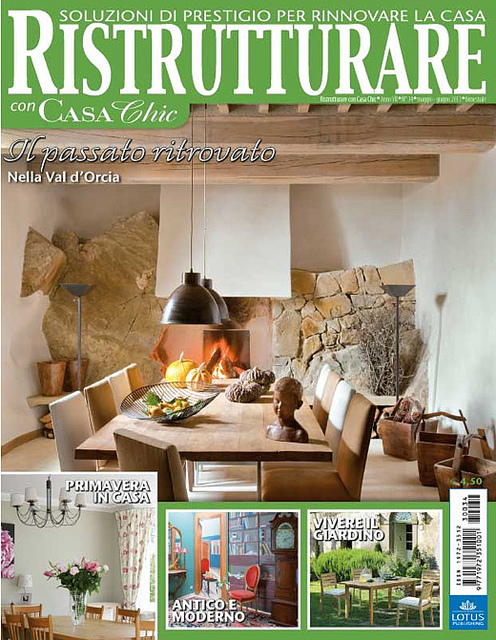
I’ll be back on track Monday. I thought I would go ahead and mention that we were recently featured in the magazine Ristrutturare con Casa Chic!

From what I can tell, the magazine is published in Italian, French, and German! Any readers out there want to send us one? We would so appreciate it!
Even though the article is not in English, I’m going to go ahead and post it in case there are some translators out there! The write up talks about the concrete table top we did for our friend Ashley and gives some step by step instructions to take on the project yourself!


See you back here on Monday! 🙂
German girl here 😉
I think the german magazines are different than the one you are featured in, but the cover looks familiar somehow. I will keep my eyes open.
Congrats! Hope the commercial shoot went well, too.
Here’s a rough translation of the article (I’ve spent a couple of summers in Italy). Hope I didn’t make any huge mistakes… I don’t know a lot of those technical words in Italian. Here goes:
Choice of character: by making a top out of concrete, Kara and Tim Paslay have given a new look to a simple wooden table.
Kara and Tim describe themselves as ‘a design and fabrication team comprised of a husband and wife’ and it’s that passion for DIY which has bound their personal stories. Tim began working in general construction technologies straight out of college, and ever since has been learning new things and finding innovative ways to use common materials. Kara, on the other hand, knew she wanted to be a designer while she was still in college, but unfortunately her school didn’t offer such classes, and because she was on a basketball scholarship, transferring was not a practical option. It was then that she decided to use her abilities to her advantage. After spending a year playing professional basketball in Lithuania, Kara returned home to the States and made a home together with Tim. Together they have used their home as a place to try new techniques by trial and error. This is how their environment has become their first portfolio: the photos are published on their blog and gradually they’ve earned a following of readers and admirers in the world of design. In time, thanks to their respective abilities, the couple has succeeded in turning their passion for DIY into a true activity. Generally, Kara plays the role of designer, while Tim dedicates himself to the construction, but their roles are sometimes reversed. The table we show you in these pages represents a recent project of theirs developed by a third person and we have decided to show it to you because it utilizes a material generally considered for construction: concrete.
“We fell in love with this material while flipping through specialty magazines which showed it being used for almost anything, from kitchen countertops to pavement,” they explained to us, “and so we started to experiment, starting with little projects in our own home. A short time later, our photographer friend asked us to make her a concrete tabletop, and in exchange she offered to take some shots for our blog.”
“We love concrete because, depending on the finish, it can appear organic or industrial. It can resemble a natural material, but it also has a very clean and modern aspect. Concrete is really versatile. It can be adapted to any style, which can render it sleek and modern or it can take on a more traditional finish. Furthermore, it can take on different colors, by adding pigment to the paste. Our friend’s home is full of life and character, and so she requested a table that would withstand the activities of her children. And the beautiful thing is that the more it’s used, the more charming it seems. Because we were simply creating a new top for an existing table, we didn’t have to study a specific design for this piece. All we had to do was get the measurements and make sure we had enough concrete.”
To make it: “To create a simple shape for the top of this rectangular table, I first create a melamine mold—but you could use formica—supported by a big, wooden table. We cut the melamine to the measure of the top of the wood and with the rest of the sheet we cut four strips of melamine about 3-4 cm tall and of the same length as the sides of the face of the table. Then we fixed the strips between theirs with the real ones (?). Remember to carefully control the angles and the measures of your mold to be sure that they are correct. The angles should be 90 degrees and the strips should be perfectly straight. At this point, you should use the silicone sealant on all the joints of the melamine mold and pay attention to smooth it out carefully, because every little defect in the silicone will be duplicated in the concrete. Usually we like to make a frame to reinforce the mold using round steel bars, but as long as the base of your table is solid, you could just use two bars along the long sides. Let the silicone dry for 24 hours. Now you are ready to work with the concrete, but first you must protect your hands and eyes with gloves and goggles, and wear appropriate work clothes. For this simple project, we used a basic concrete mix. The hardest part is adding just the right amount of water. If you add too much, the concrete mix will be easy to pour into the mold, but it will be weak, and after drying it may crack easily. On the other hand, if too little water is added, the concrete will be too dry and hard, and it will be difficult to spread it evenly throughout the mold. Additionally, too many air bubbles could form, which are difficult to remove. Once all the concrete has been poured into the mold, level it using a wooden board moved in a zig-zag pattern.”
“Let it sit for around 30 minutes, then start leveling it with the typical tools to get a perfectly smooth concrete surface. You must be patient, and you can’t do anything to it in the first hour, because it takes time for concrete to set well. Depending on the temperature and humidity where you find yourself working, as well as the dimensions of your tabletop, we advise you to use the leveler for a few minutes every hour and a half until it’s completely dry.”
Wow! (Thanks for the above translation.) Gorgeous table make-over, and loving the doily runner! You two are a great team. Thanks for FabLab info in last post- I am signing up for the Baltimore one this summer!